Decoding Acoustic Engineering Behind Multi-Venue Soundscapes That Prevent Overlap in Adjacent Properties
Written by Willa Hartmann · Jun 13, 2026
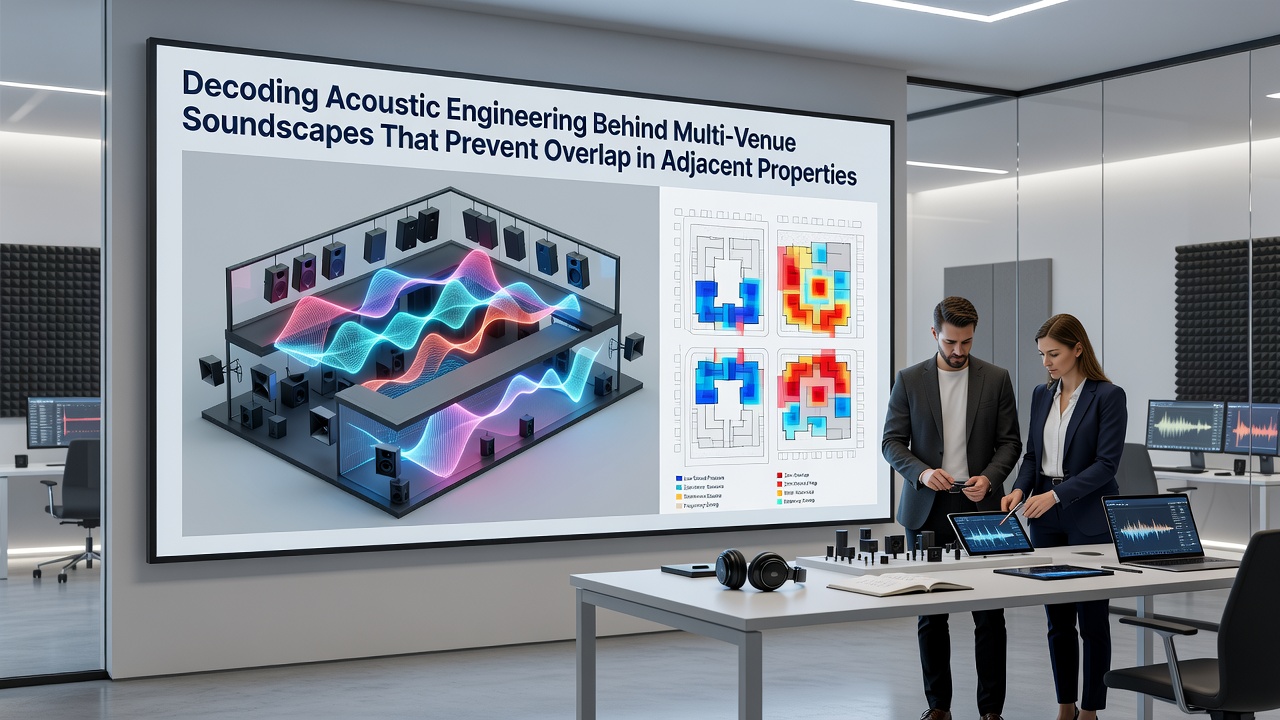
Decoding Acoustic Engineering Behind Multi-Venue Soundscapes That Prevent Overlap in Adjacent Properties
Urban entertainment districts pack multiple performance spaces, nightclubs, and theaters into tight footprints, and acoustic engineering teams now rely on layered technologies to keep each venue's audio distinct. Researchers at institutions across North America and Europe have documented how these systems combine physical barriers, digital signal processing, and real-time monitoring to stop sound from bleeding into neighboring properties. Data from the Australian Acoustical Society shows that properly calibrated installations can reduce spillover by up to 35 decibels in high-density zones, allowing simultaneous events without regulatory violations.
Core Challenges in Dense Venue Clusters
Sound waves travel through air and building structures with little regard for property lines, so engineers must address both airborne and structure-borne transmission. Low-frequency bass from nightclub subwoofers penetrates walls and foundations more readily than higher frequencies, while mid-range vocals from live stages carry farther outdoors. Observers note that venues separated by only a few meters of corridor or shared wall face the greatest risk of overlap, particularly when one space hosts amplified music and another runs spoken-word programming. Studies conducted by the Canadian Acoustical Association confirm that without intervention, sound levels can rise 15 to 20 decibels above ambient in adjacent rooms during peak hours.
Technologies That Shape Controlled Sound Fields
Directional speaker arrays focus audio energy into narrow beams that stay inside the intended listening area, and beamforming algorithms adjust output in milliseconds based on audience movement. Acoustic consultants install Helmholtz resonators and tuned mass dampers inside shared walls to absorb specific frequencies before they propagate further. Software platforms such as Odeon and CATT-Acoustic model entire building complexes in three dimensions, allowing designers to predict reflections off glass facades and adjust speaker placement before construction begins. In June 2026 the International Congress on Acoustics will convene in Las Vegas to review field data from these modeling tools, with sessions scheduled on adaptive masking systems that introduce subtle background noise to mask residual leakage without raising overall volume.
Integration With Venue Operations and Regulations
Property managers coordinate with acoustic specialists during booking schedules so that high-volume events do not run simultaneously in directly adjacent spaces. Real-time sensors feed data to central control rooms where technicians can lower output on one system or activate additional absorption panels automatically. European Union directives on environmental noise require continuous logging of sound levels at property boundaries, and similar requirements appear in several U.S. municipal codes. Figures released by the National Research Council of Canada indicate that venues using integrated monitoring cut compliance complaints by roughly 60 percent compared with facilities relying on manual checks alone.
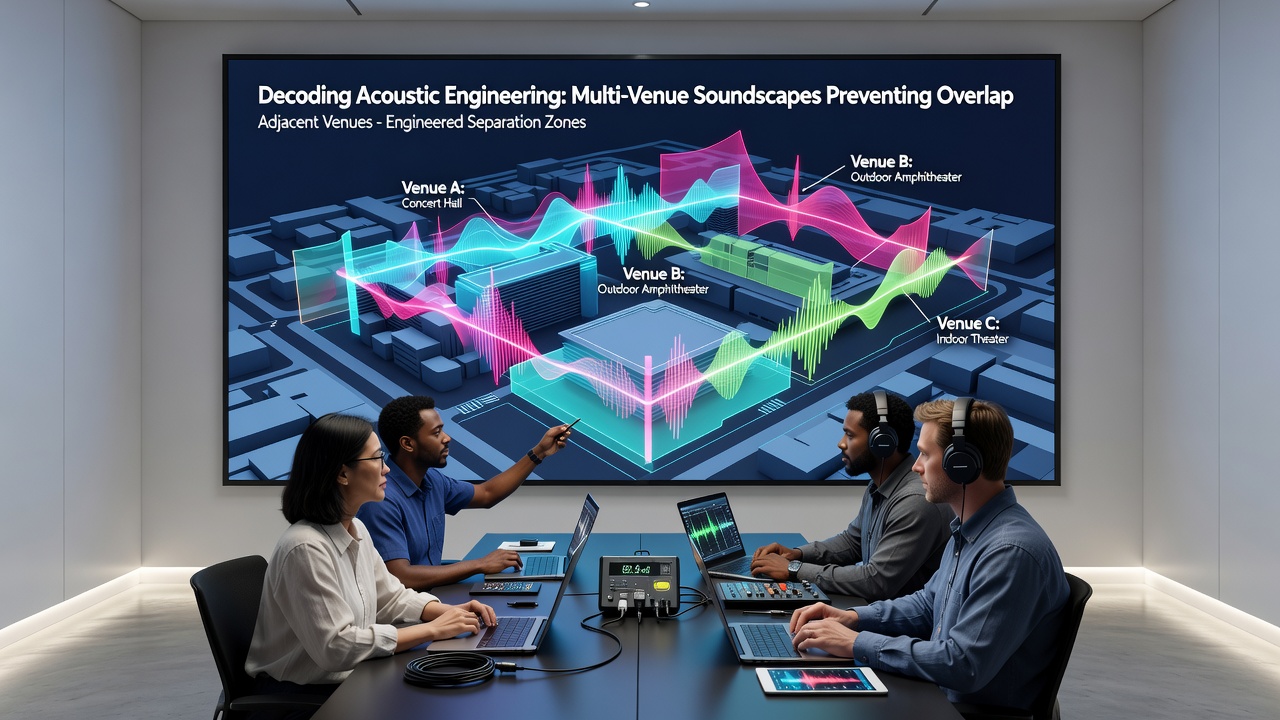
Case Examples From Operational Districts
One entertainment complex in a major resort corridor installed cardioid subwoofer arrays along its eastern edge, directing low-frequency energy inward while canceling outward propagation. Measurements taken after installation showed boundary levels remained below 55 decibels even when interior volumes reached 105 decibels. Another property combined active noise cancellation mats in service corridors with white-noise emitters in public walkways, creating a buffer zone that masked residual audio without drawing attention. Those who've studied these deployments report that guest satisfaction scores stayed consistent because the masking remained imperceptible inside each venue yet effective at the property line.
Maintenance and Continuous Calibration
Systems require periodic recalibration because temperature changes, humidity shifts, and equipment aging alter acoustic behavior. Technicians perform quarterly sweeps using calibrated microphones and update digital signal processor settings to match current conditions. Predictive maintenance software flags when absorption materials lose effectiveness, prompting replacement before complaints arise. Research published by the Acoustical Society of America emphasizes that consistent upkeep preserves the original performance margins and avoids costly retrofits later.
Conclusion
Acoustic engineering for multi-venue environments relies on the coordinated application of physical design, digital processing, and ongoing measurement. Properties that adopt these methods maintain distinct soundscapes for each space while meeting regulatory thresholds at shared boundaries. Continued advances in sensor networks and modeling software, highlighted at events such as the 2026 congress, point toward even tighter control in future installations.